Category Creation vs Category Capture: The GTM Decision That Determines Your Runway


Every B2B SaaS founder faces a fork in the road during their go-to-market journey. On one path sits Category Creation: defining a brand-new space, educating the market on an unseen problem, and attempting to own the mental real estate forever. On the other path sits Category Capture: entering an established, highly searched market with a clearly differentiated angle and stealing market share from legacy players.
Choosing the wrong path doesn't just mean a missed Q3 target—it fundamentally reshapes your burn rate, customer acquisition costs (CAC), and runway.
Understanding the trade-offs between creating a category and capturing an existing one is vital, along with learning how to evaluate which path fits your product’s architecture and financial reality.
The Illusion of Category Creation
Category creation has an almost mythical status in Silicon Valley. We talk about Salesforce inventing Cloud CRM, HubSpot defining Inbound Marketing, or Gainsight creating Customer Success.
When it works, the economics are staggering. Category creators regularly capture up to 76% of the total market capitalization in their space. But what the textbooks rarely emphasise is the mortality rate.
Creating a category is an exercise in market education. You aren’t taking orders from buyers who already have budget allocated; you are convincing buyers that a problem they have lived with for years is suddenly intolerable.

The Real Cost of Category Creation
Education Tax: You pay for every blog post, podcast, analyst briefing, and event required to explain why the problem exists before you can ever pitch how your software solves it.
Longer Sales Cycles: Deals stall not because competitors beat you, but because prospects revert to the status quo ("We'll just handle this in Excel for another year").
Budget Extraction: Buyers don't have a line item for your product. You have to convince them to reallocate budget from another line item or secure incremental funding from executive leadership.
If you have $2M in seed funding and 18 months of runway, running a category creation strategy often means running out of cash just as the market finally starts to understand what you do.
Category Capture: The Precision Strike Strategy
Category Capture gets an undeserved reputation as the less ambitious path. In reality, it is often the smartest, most capital-efficient way to build a high-growth SaaS business.
When you capture a category, you target a space where search intent already exists, buyers have dedicated line-item budgets, and the pain points of legacy software are widely documented.
Your goal isn't to invent a new problem. It is to expose the flaws of existing solutions and position your product as the obvious, modern alternative.
The Mechanics of Winning via Category Capture
Instead of educating the entire market, your GTM team focuses on three distinct strategic vectors:
Unbundling the incumbent: Identify a high-value niche within a massive platform (e.g., building a dedicated, high-performance scheduling engine instead of using a bloated enterprise HR suite).
Workflow specialization: Adapt a generic solution for a specific vertical with tailored requirements (e.g., "CRM for Commercial Real Estate" vs. a generic CRM).
Architectural shift: Capitalize on a fundamental shift in technology, data privacy, or work habits (e.g., real-time collaborative interfaces vs. static desktop files).
By anchoring your messaging to a category buyers already understand, your sales team spends 80% of the call showing value rather than explaining concepts.
Evaluating Your Path: The Decision Matrix
To determine which GTM motion matches your business reality, evaluate your company against these core dimensions:
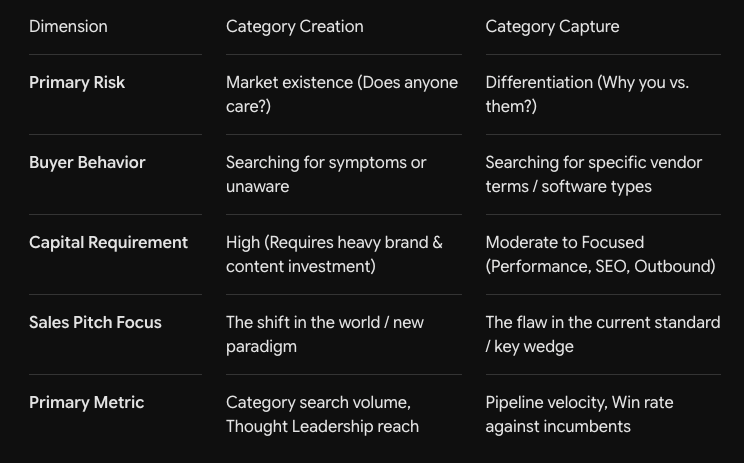
If your buyers are actively searching for "best contract management software for legal teams," running a Category Creation campaign around "Legal Velocity Engines" creates unnecessary friction.
Conversely, if you offer a product that solves an issue buyers don't yet realize they have, attempting pure Category Capture will yield low search volume and poor ad conversions.
Aligning Your Positioning Architecture with Your GTM Motion
Whether you choose to define a new category or dominate an existing one, success hinges entirely on your positioning architecture.
Your GTM strategy fails when your internal strategy doesn't match the buyer's mental model.
The Category Creation Trap: If you claim to invent a new category but your sales deck immediately devolves into a feature comparison against an incumbent, you confuse your prospects and force them back to the status quo.
The Category Capture Trap: If you attempt category capture without a sharp, highly specific positioning wedge, you get crushed on price and brand recognition by entrenched enterprise vendors.
To dive deeper into constructing a rock-solid positioning strategy that supports your GTM motion, explore these foundational guides on positioning and messaging hierarchy:
Building a Messaging Hierarchy That Converts: How to structure your value propositions from high-level strategic narrative down to granular feature benefits.
The SaaS Positioning Framework for Mid-Funnel Velocity: Why pipeline stalls between demo and closed-won, and how to fix your market wedge.
Competitive Battlecards That Win Deals: Arming your sales reps to execute category capture strategies against entrenched incumbents.
Where Strategy Meets the Street: Fixing Your Sales Deck Today
Your category decision isn't an abstract board exercise—it lives or dies in the first 10 minutes of a sales call. If you are creating a category, your deck must sell the inevitability of a new problem. If you are capturing a category, your deck must expose the hidden tax of the incumbent solution.
Transforming your pitch deck requires shifting focus from what your product is to what your product enables in the context of your GTM motion.
Audit your current deck against these three diagnostic questions:
Does the first slide talk about us, or does it talk about a market reality our buyer experiences? (Category creators must establish a fundamental market shift; category captors must pinpoint an undeniable current friction.)
Are features introduced as standalone items, or as solutions to specific strategic obstacles? (If your features look like a checklist, you fall into the commodity trap regardless of your category goal.)
Can a new rep deliver this deck as a coherent story without reading bullet points off the screen? (A great category narrative gives sales reps a repeatable framework to guide the customer’s buying journey.)
Rebuilding your sales presentation around the buyer's journey ensures your team delivers value in every interaction, turning standard pitch meetings into revenue-generating conversations.
Is Your Sales Deck Narrative Leaking Pipeline to Competitors?
At Digital Digestion, we help growth-stage B2B SaaS companies (Series A and B) refine their positioning, reconstruct high-converting sales deck narratives, build competitive battlecards, and align their sales enablement assets to win more deals.
If you want a clinical, objective review of your current messaging hierarchy and sales deck structure, let's look under the hood together.
Book a GTM Diagnostic Call to pinpoint exactly where your mid-funnel deals are stalling and how to transform your sales deck into a high-converting revenue narrative.


Comments